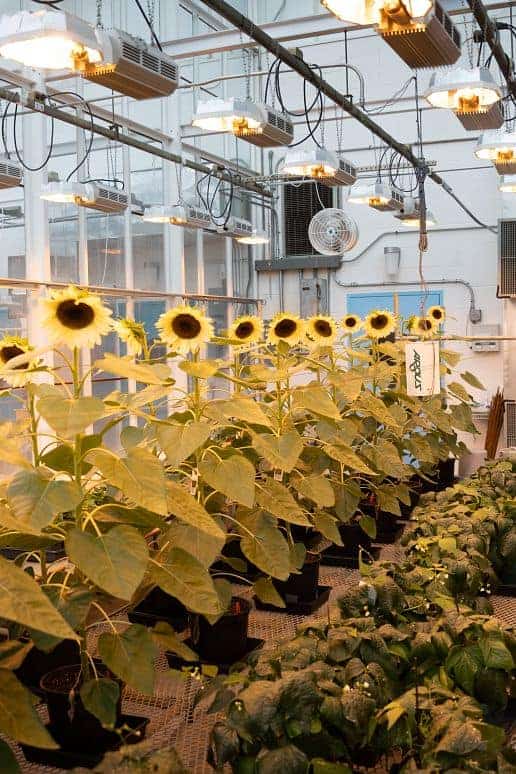
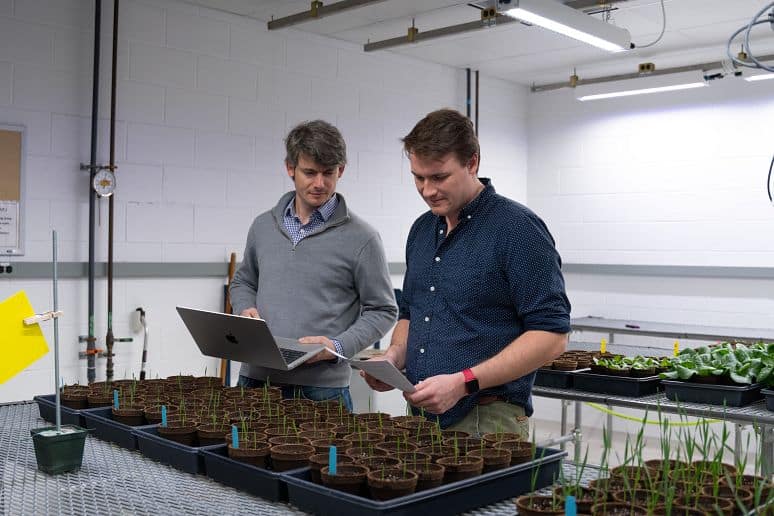
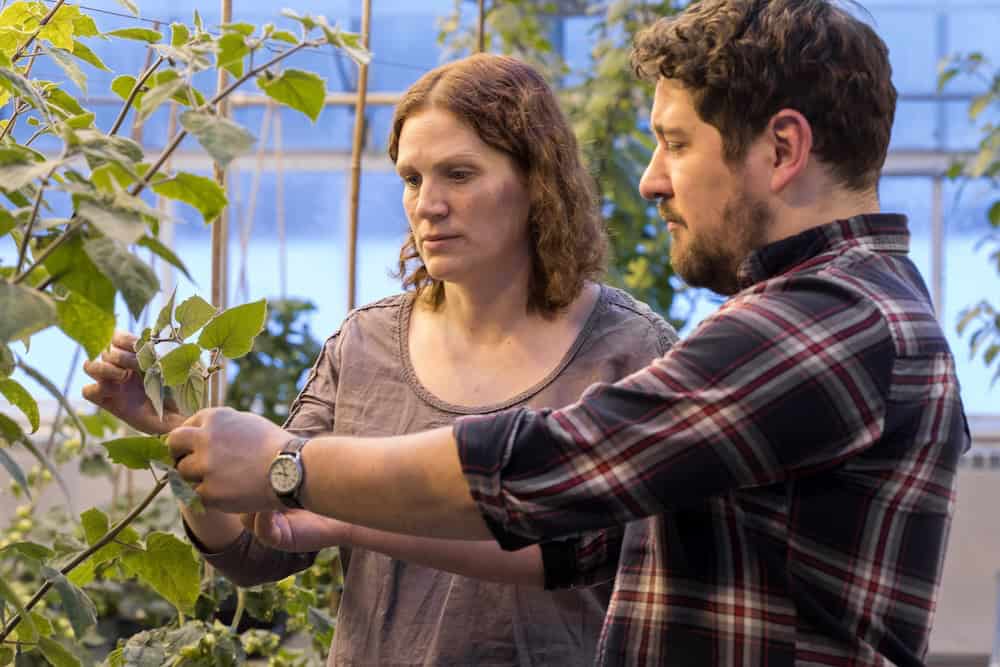
BTI’s Plant Growth Facility encompasses approximately 25,000 sq. ft. of space within a private, not-for-profit research facility, located on the Cornell University campus in Ithaca, NY. This multi-faceted facility, which services a wide array of research projects, consists of greenhouses, growth chambers, a dew room, a plant functional genomics room, a plant pathogen room, and a seed harvest room.

Specific facility components include:
- Greenhouses: a total of 20 greenhouses, 480 sq. ft. each, controlled and monitored by an
ARGUS computer automated greenhouse control system designed
specifically to control the highly dynamic climate variables in greenhouses. Six units are air-conditioned
with chilled water and fourteen units use evaporative cooling. - Conviron Growth Chambers: A total of 40 chambers, including 16 walk-in chambers totaling 3,854 sq. ft., and
24 reach-in chambers totaling 401 sq. ft. - Dew Room: 72 sq. ft.
- Plant functional genomics room: 600 sq. ft.
- Plant pathogen room: A 267 sq. ft. isolated room where plant pathogens may be used.
- Seed harvest room: totaling 520 sq. ft. where plants can be finished, dried down and harvested.
The Plant Growth Facility is managed based on the following principles:
- Goal – To use an Integrated Pest Management approach to achieve optimum plant growth and provide excellent
facilities and services in support of the research staff. - Vision – To operate a state-of-the-art plant growth facility, providing the highest quality research plants.
- Focus – A proactive service-oriented approach that will anticipate the needs of the growth facility users.
The Plant Growth Facility operates in compliance with BTI, Cornell University, and State and Federal Regulations, including the Worker Protection Standard, Best Management Practices, all transgenic requirements, and pesticide regulations.
For more information, please be in touch with Brian Bell at bkb3@cornell.edu.
Frequently Asked Questions
How do I start a greenhouse or growth chamber project?
If you are interested in renting greenhouse or chamber space, please complete the
Growth Facility Space Request
(PDF) and return it to the Greenhouse Manager. Every effort will be made to provide
the appropriate growth space.
What kinds of greenhouses and chambers are available and what is the cost?
There are 14 evaporative cooled and 6 air conditioned greenhouses as well as many different sizes of growth chambers.
To see sq. footage and space fee details you can look at the
Greenhouse and
Growth Chamber Space Inventory (PDF). To see lighting information in greenhouses and
chambers look at the Greenhouse and Growth Chamber Lighting Inventory
(PDF).
What supplies are in stock for growth facility users?
The greenhouse staff will provide an inventory of commonly used pots and trays. After use, the dirty pots will be
disinfected and washed at no extra charge to the user.
Pots, trays, cones, etc. which are not part of the inventory and which are purchased by the projects, may be washed at no
charge if these items are added to the inventory at the end of the project. If not added to the pot inventory, an
hourly pot-washing fee may apply.
See Plant Growth Facility Supplies
(PDF) for a more detailed description of available inventory.
What services are provided by greenhouse staff?
All plant material receives plant care unless the growth facility user requests otherwise.
The fee for plant care will be charged even if the user declines some components. The greenhouse
staff may provide additional services at an hourly rate of $25.00/hr. Services include the following. Please see
Plant Growth Facility Use Policy, Section 4.0
(PDF) for a complete description.
- Watering 365 days/year
- Pest and disease scouting
- Cultural, biological, or chemical pest control
- Environmental control
- Photoperiod control
- Graphing of temperatures upon request
- Greenhouse or growth chamber maintenance
- Routine greenhouse or growth chamber sanitation
- Plant material autoclaving
- Routine application of fertilizer
- Seasonal application of shade material
- Routine seed sowing and transplanting
- Routine washing of inventoried pots and trays.
What are user responsibilities?
Growth facility users must share the responsibility for quality plant care with the greenhouse staff.
Open communication regarding the monitoring and maintenance of plant demands will facilitate optimum plant
development, reduce problems and promote productive relationships between users and staff.
Users are responsible for the following. Please see
Plant Growth Facility Use Policy, Section 6.0
(PDF) for a complete description.
- Keeping growth areas clean.
- Removing unwanted plants from growth areas immediately after finishing with them.
- Communicating plant care issues (insects and diseases, fertility, etc.).
- Keeping growth and work areas sanitary and orderly.
- Using proper pot size and pot filling technique.
- Keeping plants staked, tied, pruned and properly spaced at all times.
- Placing pots only on bench space, not on floors or windowsills.
- Removing any plant parts such from benches and floors and disposing of properly.
- Washing pots or trays that are not part of the growth facility inventory.
What are the requirements for growing Arabidopsis?
What is the procedure for using plant pathogens at BTI?
- Fill out the Pathogen Use Form
- Read the Pathogen containment
facility SOP for room 216
What are the requirements for growing genetically modified plants?
All research involving transgenic plants must be registered with the Institutional Biosafety Committee (IBC).
For more information, visit: http://www.ibc.cornell.edu/
Certain plants must be autoclaved before disposal, including those that are:
- Transgenic
- Virus-infected
- Legally quarantined
- Otherwise biologically hazardous
- Otherwise required to be autoclaved by research protocols
- All other plants in the same growth room as above listed plants
Project personnel are responsible for:
- Picking up an autoclave bag from the autoclave area in the head house
- Bagging all plant material, fruit and plant parts in the greenhouse or growth chamber
- Working with the greenhouse staff to ensure the material is autoclaved
- Making sure there is no plastic in the autoclave bags
Autoclaving will be done by the greenhouse staff.
For more information
For further details, see the Plant Growth Facility Use Policy
or contact Brian Bell at bkb3@cornell.edu.
Use Policy
Below are the sections and section titles of the Use Policy
Download the entire policy or individual sections (PDF)
- Introduction and Mission Statement (PDF)
- Contact Information (PDF)
- Growth Facility Space Requests (PDF)
- Services Provided by Greenhouse Personnel (PDF)
- Supplies Provided (PDF)
- Growth Facility User Responsibilities (PDF)
- Communication (PDF)
- Plants (PDF)
- Housekeeping (PDF)
- Best Management Practices at BTI and Cornell
- General Safety (PDF)
- The Worker Protection Standard (PDF)
- Biohazardous and Transgenic Plant materials (PDF)
- Pathogen and Insect Use Policy (PDF)
Lighting and Facility Inventories
Greenhouse and Growth Chamber Lighting (PDF)
View bulb type and number of bulbs per space located in each of our greenhouses, growth chambers, dew room and seed harvest room.
Greenhouse and Growth Chamber Space Inventory (PDF)
View length/width/area and monthly charges for each of our greenhouses, plant production rooms, plant growth rooms, growth chambers, and seed harvest room.
| Space | Chargeable unit | Total Area (sq. ft) |
|---|---|---|
| Greenhouses | Center or side bench | 5,149 |
| Plant Production Rooms | Rack of 3 shelves | 2,592 |
| Plant Growth Rooms | Rack of 3 shelves | 864 |
| Chambers | Shelf | 518 |
| Seed Harvest Room | 180 |
Forms
Adobe Acrobat Reader allows you to enter information but not save the document. You must print the form and deliver it to the Greenhouse. Adobe Acrobat allows you to enter information, save the document AND send as an email attachment to Greenhouse staff.
| Form (all PDF) | Purpose |
|---|---|
| Greenhouse and Growth Chamber Lighting Inventory | This describes the Greenhouse or Chamber number and lists the type and number of bulbs in each space. |
| Greenhouse and Growth Chamber Space Inventory | This describes the Greenhouse or Chamber number and shows the amount of rentable space and monthly space charges. |
| Greenhouse Department Job Request Form | Complete this form to request any services not included in basic rental fees. |
| Greenhouse Environmental Control Request and Cultural Information Form | Complete this form before starting a new experiment in a greenhouse. Use this form to update your information at the start of each year. |
| Growth Chamber Request | Complete this form before starting a new experiment in a growth chamber. Use this form to update your information at the start of each year. |
| Growth Facility Space Request | Complete this form when requesting the rental of any greenhouse or growth chamber and return it to the Greenhouse Manager. |
| Insect Use Form | Complete this form to request space where insects will be contained. |
| Pathogen Use Form | Complete this form to request space where pathogens will be contained. |
| Plant Growth Facilities Supplies | This is a complete list of the supplies stocked by the greenhouse staff. |
| Planting / Transplanting Request Form | Complete this form if you would like the greenhouse staff to do any plantings or transplanting. |
| Watering Schedule Form | Complete this form to request watering in any space not normally watered by the Greenhouse staff. |
| WPS Requirement to Provide Basic Pesticide Safety Information to Untrained Workers | Before working in any area where pesticides have been used in the last 30 days, you must read and complete this form and return it to the Greenhouse Manager. |
Other Resources
- Best Management Practices for Cornell Greenhouses (Ithaca)
- BTI Plant Growth Facilities Committee
- BTI Safety Committee
- CALS Spill Cleanup Guidelines
- Cornell Institutional Biosafety Committee
- NIH Office of Biotechnology Activities
- Environmental Health and Safety
- Environmental Health and Safety emergency phone numbers
- EPA Worker Protection Standard
- Occupational & Environmental Health, College of Agriculture & Life Sciences
- OSHA Hazard Communication Standard
For more information or to schedule a tour, contact Brian Bell at bkb3@cornell.edu.