
Assistant Professor
Office/Lab: 425/414-420
fs31@cornell.edu
Office: 607-254-4391
Lab: 607-220-9734
Research Summary
Our research is directed at characterizing structures and biological functions of biogenic small molecules (BSM’s). BSM’s play important roles in most biological processes, and detailed knowledge of their chemical structures and their interactions with other biomolecules is essential for advancing our molecular understanding of life. BSM’s regulate development and immune responses in plants and animals, and serve important functions in interactions of different organisms with each other. As a result, an organism’s metabolome essentially comprises a collection of small molecules with potentially useful affinities for specific molecular targets. Not surprisingly, BSM’s constitute the most important source of lead structures for drug development.
Compared to template-derived biological macromolecules such as proteins and nucleic acids, BSM’s are chemically much more diverse and correspondingly present great analytical challenges. As a result, genomic and proteomic knowledge has not yet been complemented by a comprehensive characterization of structures and functions of metabolomes, presenting one of the most significant barriers toward advancing our understanding of biological pathways.
The Schroeder lab aims to help close this knowledge gap by developing approaches for a more systematic structural and functional characterization of BSM’s. Usually, BSM’s occur as – often minor – components of a more or less complex biological matrix, comprising a large number of BSM’s and other biomolecules. Traditional approaches for the characterization of BSM’s such as HPLC-MS or activity-guided fractionation have distinct disadvantages that severely limit their applicability. Our aims is to develop NMR spectroscopy-based approaches that complement or enhance traditional methodology by enabling detailed characterization of BSM’s in complex biological samples, with regard to both chemical structure and biological function.
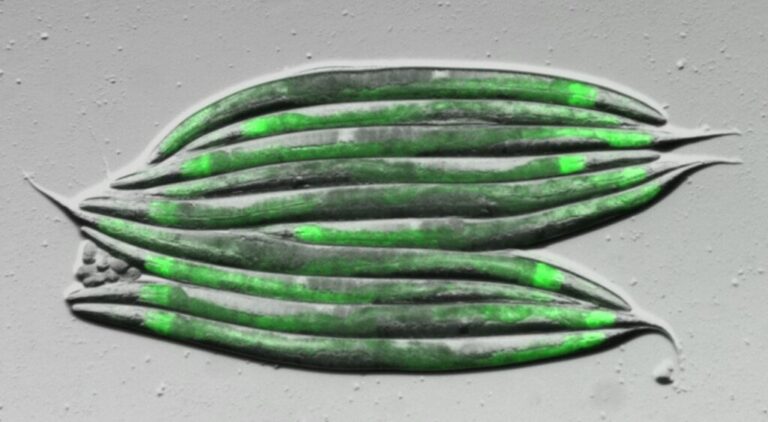
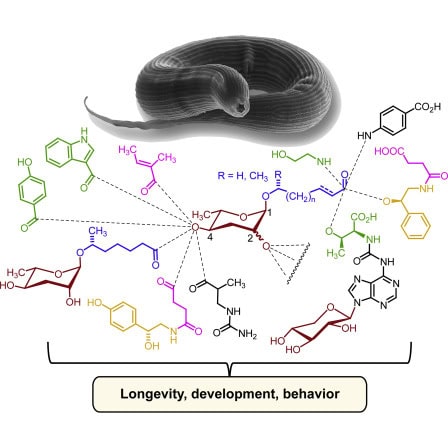
Based on NMR-spectroscopic methodology we have engaged in a comprehensive effort to characterize structures and functions of the metabolome (the entirety of all BSM’s) produced by the model organism Caenorhabditis elegans, focusing on several newly discovered compounds that control development, and ultimately lifespan. In addition we have started a project directed at investigating the chemical ecology of microorganisms in search of leads for new antibiotics. Complementing our interests in analytical chemistry, we pursue development of efficient syntheses for newly identified compounds with particular biological significance.
Please visit our research pages for more details!
Selected Publications
Bose, N., Ogawa, A., von Reuss, S.H., Yim, J.J., Ragsdale, E.J., Sommer, R.J. and Schroeder, F.C. 2012. Complex small-molecule architectures regulate phenotypic plasticity in a nematode. Angewandte Chemie 51: 12438-12443Choe, A., von Reuss, S.H., Kogan, D., Gasser, R.B., Platzer, E.G., Schroeder, F.C. and Sternberg, P.W. 2012. Ascaroside signaling is widely conserved among nematodes.. Current Biology 22: 772-780
Findeis, M.A., Schroeder, F., McKee, T.D., Yager, D., Fraering, P.C., Creaser, S.P., Austin, W.F., Clardy, J., Wang, R., Selkoe, D. and Eckman, C.B. 2012. Discovery of a novel pharmacological and structural class of gamma secretase modulators derived from the extract of Actaea racemosa.. Acs Chem Neurosci 3: 941-951
Forseth, R.R. and Schroeder, F.C.. 2012. Correlating secondary metabolite production with genetic changes using differential analysis of 2D NMR spectra.. Methods in molecular biology 944: 207-219
Hutchinson, D.A., Savitzky, A.H., Mori, A., Burghardt, G.M., Meinwald, J. and Schroeder, F.C. 2012. Chemical investigations of defensive steroid sequestration by the Asian snake Rhabdophis tigrinus. Chemoecology 22: 199-206
Izrayelit, Y., Srinivasan, J., Campbell, S.L., Jo, Y., von Reuss, S.H., Genoff, M.C., Sternberg, P.W. and Schroeder, F.C. 2012. Targeted metabolomics reveals a male pheromone and sex-specific ascaroside biosynthesis in Caenorhabditis elegans. Acs Chem Biol 7: 1321-1325
Kaplan, F., Alborn, H.T., von Reuss, S.H., Ajredini, R., Ali, J.G., Akyazi, F., Stelinski, L.L., Edison, A.S., Schroeder, F.C. and Teal, P.E. 2012. Interspecific nematode signals regulate dispersal behavior. Plos One 7: e38735
Lee, S.S. and Schroeder, F.C. 2012. Steroids as central regulators of organismal development and lifespan. PLoS Biology 10:
Li, B., Forseth, R.R., Bowers, A.A., Schroeder, F.C. and Walsh, C.T. 2012. A backup plan for self-protection: S-methylation of holomycin biosynthetic intermediates in Streptomyces clavuligerus. Chembiochem 13: 2521-2526
Park, D., O'Doherty, I., Somvanshi, R.K., Bethke, A., Schroeder, F.C., Kumar, U. and Riddle, D.L. 2012. Interaction of structure-specific and promiscuous G-protein-coupled receptors mediates small-molecule signaling in Caenorhabditis elegans. Proc Natl Acad Sci U S A 109: 9917-9922
Robinette, S.L., Bruschweiler, R., Schroeder, F.C. and Edison, A.S. 2012. NMR in metabolomics and natural products research: two sides of the same coin. Accounts of Chemical Research 45: 288-297
Srinivasan, J., von Reuss, S.H., Bose, N., Zaslaver, A., Mahanti, P., Ho, M.C., O'Doherty, O.G., Edison, A.S., Sternberg, P.W. and Schroeder, F.C. 2012. A modular library of small molecule signals regulates social behaviors in Caenorhabditis elegans. PLoS Biology 10: e1001237
von Reuss, S.H., Bose, N., Srinivasan, J., Yim, J.J., Judkins, J.C., Sternberg, P.W. and Schroeder, F.C. 2012. Comparative metabolomics reveals biogenesis of ascarosides, a modular library of small-molecule signals in C. elegans. J Am Chem Soc 134: 1817-1824
Weidner, C., de Groot, J.C., Prasad, A., Freiwald, A., Quedenau, C., Kliem, M., Witzke, A., Kodelja, V., Han, C.T., Giegold, S., Baumann, M., Klebl, B., Siems, K., Muller-Kuhrt, L., Schurmann, A., Schuler, R., Pfeiffer, A.F.H., Schroeder, F.C., Bussow, K. and Sauer, S. 2012. Amorfrutins are potent antidiabetic dietary natural products. Proc Natl Acad Sci U S A 109: 7257-7262
Robinette, S.L., Ajredini, R., Rasheed, H., Zeinomar, A., Schroeder, F.C., Dossey, A.T. and Edison, A.S. 2011. Hierarchical alignment and full resolution pattern recognition of 2D NMR spectra: Application to nematode chemical ecology. Anal Chem 83: 1649-1657
O'Doherty, I., Yim, J.J., Schmelz, E.A. and Schroeder, F.C. 2011. Synthesis of caeliferins, elicitors of plant immune responses: accessing lipophilic natural products via cross metathesis. Org Lett 13: 5900-5903
Kaplan, F., Srinivasan, J., Mahanti, P., Ajredini, R., Durak, O., Nimalendran, R., Sternberg, P.W., Teal, P.E.A., Schroeder, F.C., Edison, A.S. and Alborn, H.T. 2011. Ascaroside expression in Caenorhabditis elegans is strongly dependent on diet and developmental stage. Plos One 6: e17804
Jiang, W., Heemstra Jr., J.S., Forseth, R.R., Neumann, C.S., Manaviazar, S., Schroeder, F.C., Hale, K.J. and Walsh, C.T. 2011. Biosynthetic Chlorination of the Piperazate Residue in Kutzneride Biosynthesis by KthP. Biochemistry 50: 6063-6072
Forseth, R.R. and Schroeder, F.C. 2011. NMR-spectroscopic analysis of mixtures: from structure to function. Curr Opin Chem Biol 15: 38-47
Forseth, R.R., Fox, E.M., Chung, D., Howlett, B.J., Keller, N.P. and Schroeder, F.C. 2011. Identification of cryptic products of the gliotoxin gene cluster using NMR-based comparative metabolomics and a model for gliotoxin biosynthesis. J Am Chem Soc 133: 9678-9681
Deyrup, S.T., Eckman, L.E., McCarthy, P.H., Smedley, S.R., Meinwald, J. and Schroeder, F.C. 2011. 2D NMR-spectroscopic screening reveals polyketides in ladybugs. Proc Natl Acad Sci U S A 108: 9753-9758
Chung, K., Zhan, M., Srinivasan, J., Sternberg, P.W., Gong, E., Schroeder, F.C. and Lu, H. 2011. Microfluidic chamber arrays for whole-organism behavior-based chemical screening. Lab Chip 11: 3689-3697
Chavez, K.J., Feng, X., Flanders, J.A., Rodriguez, E. and Schroeder, F.C. 2011. Spirocyclic lignans from Guaiacum (Zygophyllaceae) induce apoptosis in human breast cancer cell lines. J Nat Prod 74: 1293-1297
Caspers, B.A., Schroeder, F.C., Franke, S. and Voigt, C.C. 2011. Scents of adolescence: The maturation of the olfactory phenotype in a free-ranging mammal. Plos One 6: e21162
Mukerjee, P., Abid, M. and Schroeder, F.C. 2010. Highly alpha-selective hydrolysis of alpha,beta-epoxyalcohols using tetrabutylammonium fluoride. Org Lett 12: 3986-3989
Gronquist , M. and Schroeder, F.C. 2010. Insect Natural Products. In Comprehensive Natural Products Chemistry II (Mander, L. and Liu, H.-W. eds)Oxford 0: Elsevier
Forseth, R.R. and Schroeder, F.C. 2010. NMR-spectroscopic analysis of mixtures: from structure to function. Curr Opin Chem Biol 0:
Edison, A.S. and Schroeder, F.C. 2010. Small Molecules and Analysis of Complex Mixtures. In Comprehensive Natural Products Chemistry II (Mander, L. and Liu, H.-W. eds) 0:
Pungaliya, C., Srinivasan, J., Fox, B.W., Malik, R.U., Ludewig, A.H., Sternberg, P.W. and Schroeder, F.C. 2009. A shortcut to identifying small molecule signals that regulate behavior and development in Caenorhabditis elegans. P Natl Acad Sci USA 106: 7708-7713
Caspers, B.A., Schroeder, F.C., Franke, S., Streich, W.J. and Voigt, C.C. 2009. Odour-based species recognition in two sympatric species of sac-winged bats (Saccopteryx bilineata, S-leptura): combining chemical analyses, behavioural observations and odour preference tests. Behav Ecol Sociobiol 63: 741-749
Srinivasan, J., Kaplan, F., Ajredini, R., Zachariah, C., Alborn, H.T., Teal, P.E.A., Malik, R.U., Edison, A.S., Sternberg, P.W. and Schroeder, F.C. 2008. A blend of small molecules regulates both mating and development in Caenorhabditis elegans. Nature 454: 1115-U1146
Schroeder, F.C., Taggi, A.E., Gronquist, M., Malik, R.U., Grant, J.B., Eisner, T. and Meinwald, J. 2008. NMR-spectroscopic screening of spider venom reveals sulfated nucleosides as major components for the brown recluse and related species. P Natl Acad Sci USA 105: 14283-14287
Kim, J.H., Lee, B.W., Schroeder, F.C. and Jander, G. 2008. Identification of indole glucosinolate breakdown products with antifeedant effects on Myzus persicae (green peach aphid). Plant Journal 54: 1015-1026
Hutchinson, D.A., Savitzky, A.H., Mori, A., Meinwald, J. and Schroeder, F.C. 2008. Maternal provisioning of sequestered defensive steroids by the Asian snake Rhabdophis tigrinus. Chemoecology 18: 181-190
Eisner, T., Schroeder, F.C., Snyder, N., Grant, J.B., Aneshansley, D.J., Utterback, D., Meinwald, J. and Eisner, M. 2008. Defensive chemistry of lycid beetles and of mimetic cerambycid beetles that feed on them. Chemoecology 18: 109-119
Chatterjee, A., Schroeder, F.C., Jurgenson, C.T., Ealick, S.E. and Begley, T.P. 2008. Biosynthesis of the thiamin-thiazole in eukaryotes: Identification of a thiazole tautomer intermediate. J Am Chem Soc 130: 11394-11398
Butcher, R.A., M. Fujita, F.C. Schroeder & J. Clardy. 2007. Small-molecule pheromones that control dauer development in Caenorhabditis elegans. Nat. Chem. Biol. 0: 420-422
Butcher, R.A., F.C. Schroeder, M.A. Fischbach, C.T. Walsh, and J. Clardy. 2007. The identification of bacillaene, the product of the PksX megacomplex in Bacillus subtilis. Proc. Natl. Acad. Sci. USA 104: 1506-1509
Hutchinson, D., A. Mori, A. Savitzky, G. Burghardt, X, Wu, J. Meinwald, F.C. Schroeder. 2007. Dietary sequestration of defensive steroids in nuchal glands of the Asian Snake Rhabdophis tigrinus. Proc. Natl. Acad. Sci. USA 104: 2265-2270
Chatterjee, A., C.T. Jurgenson, F.C. Schroeder, S.E. Ealick, and T.P. Begley. 2007. Biosynthesis of thiamin thiazole in eukaryotes: Conversion of NAD to an advanced intermediate. J. Am. Chem. Soc. 129: 2914-2922
Schroeder, F.C., D.M. Gibson, A.C.L. Churchill, E.J. Wursthorn, S.B. Krasnoff, and J. Clardy. 2007. Differential analysis of 2D NMR spectra: New natural products from a pilot-scale fungal extract library. Angew. Chem. Int. Ed. 46: 901
Spiegel, D.A., F.C.. Schroeder and S.L. Schreiber. 2006. An oligomerization approach to generating skeletal diversity. J. Am. Chem. Soc. 128: 14766-14767
Schroeder, F.C., M. Gronquist. 2006. Extending the scope of NMR spectroscopy with microcoil probes. Angew. Chem. Int. Ed. 45: 7122-7131
Chatterjee, A., C.T. Jurgenson, F.C. Schroeder, S.E. Ealick, T.P. Begley. 2006. Thiamin biosynthesis in eukaryotes: Characterization of the enzyme-bound product of thiazole synthase from Saccharomyces cerevisiae and its implications in thiazole biosynthesis. J. Am. Chem. Soc. 128: 7158-7159
Schroeder, Frank C, . 2006. Small molecule signaling in Caenorhabditis elegans. ACS Chem. Biol. 1: 198-200
Maloney, K.N., W. Hao, J. Xu, J. Gibbons, J. Hucul, D. Roll, S.F. Brady, F.C. Schroeder, J. Clardy. 2006. Phaeosphaeride A, An inhibitor of STAT3-dependent signaling isolated from an endophytic fungus. Org. Lett. 8: 4067-4070
Ueki, M., D.P. Galonić, F.H. Vaillancourt, S. Garneau-Tsodikova, E. Yeh, D.A. Vosburg, F.C. Schroeder, H. Osada, C.T. Walsh. 2006. Enzymatic generation of the antimetabolite γ,γ-dichloroaminobutyrate by NRPS and mononuclear iron halogenase action in a streptomycete. Chem. Biol. 13: 1183-1191
Schroeder, F.C, J.B. Grant, D.B. Weibel, S.R. Smedley, K.L. Bolton, J. Meinwald, T. Eisner. 2006. Pinoresinol: a basic lignol of plant origin, appropriated for defensive purposes by a caterpillar. Proc. Natl. Acad. Sci. 103: 15497-15501
Gronquist, M., F.C. Schroeder, H. Ghiradella, D. Hill, E.M. McCoy, J. Meinwald and T. Eisner. 2006. Shunning the night to elude the hunter: diurnal fireflies and the . Chemoecology 16: 10810-10811
Gronquist, M, J. Meinwald, T. Eisner, F.C. Schroeder. 2005. Exploring uncharted terrain in nature's structure space using capillary NMR spectroscopy: 13 steroids from 50 fireflies. J. Am. Chem. Soc. 127: 10810-10811
Schroeder, F.C., T.R. Kau, P.A. Silver, J. Clardy. 2005. The psammaplysenes, specific inhibitors of FOXO1a nuclear export. J. Nat. Prod. 68: 574
Taggi, A.E., J. Meinwald, F.C. Schroeder. 2004. A new approach to natural products discovery exemplified by the identification of sulfated nucleosides in spider venom. J. Am. Chem. Soc. 126: 10364-10369
Schroeder, F.C, D.B. Weibel, J. Meinwald. 2004. Chiral silylation reagents: Determining configuration via NMR-spectroscopic co-analysis. Org. Lett, 6: 3019-3022
Yack, J. E., W.E. Conner, T.A. Timbers, A. Aiello, F.C. Schroeder. 2003. Defensive . J. Lep. Soc. 0: 34-47
Kau, T.R., F.C. Schroeder, C.L. Wojciechowski, J.J. Zhou, T. Roberts, J. Clardy, W.R. Sellers, P.A. Silver. 2003. A chemical genetic screen identifies inhibitors of regulated nuclear export of a Forkhead transcription factor in PTEN-deficient tumor cells. Cancer Cell 0: 463-476
Tsao, R., A.B. Attygalle, F.C. Schroeder, C.H. Marvin, B.D. McGarvey. 2003. Isobutylamides of unsaturated fatty acids from chrysanthemum morifolium associated with host-plant resistance against the Western Flower Thrips. J. Natl. Prod. 66: 1229-1231
McGarvey, B.D., A.B. Attygalle, A.N. Starratt, J.E. Brandle, B. Xiang, F.C. Schroeder, and J. Meinwald. 2003. New non-glycosidic diterpenes from leaves of Stevia rebaudiana. J. Nat. Prod. 66: 1395-1398
Williamson, R.T., A.C. Barrios Sosa, A. Mitra, P.J. Seaton, D.B. Weibel, F.C. Schroeder. 2003. New silyl ether reagents for the absolute stereochemical determination of secondary alcohols. Org. Lett. 0: 1745-1748
Roque-Albelo, L., F.C. Schroeder, W.E. Conner, A. Bezzerides, E.R. Hoebeke, J. Meinwald, T. Eisner. 2003. Chemical defense and aposematism: the case of Utetheisa galapagensis. Chemoecology 12: 153-157
Weibel, D.B., L.E. Shevy, F.C. Schroeder, J. Meinwald. 2002. Synthesis of Mayolene-16 and Mayolene-18: Larval defensive lipids from the European Cabbage Butterfly. J. Org. Chem. 67: 5896-5900
Smedley, S.R., F.C. Schroeder, D.B. Weibel, J. Meinwald, K.A. Lafleur, J.A. Renwick, R. Rutowski, and T. Eisner. 2002. Mayolenes: Labile defensive lipids from the glandular hairs of a caterpillar (Pieris rapae). Proc. Natl. Acad. Sci. USA 99: 6822-6827
Reinhard, J., M.J. Lacey, F. Ibarra, F. Schroeder, M. Kaib, M. Lenz. 2002. Hydroquinone: a general phagostimulating pheromone in termites. J. Chem. Ecol. 28: 1-14
Darling, D.C., F.C. Schroeder, J. Meinwald, M. Eisner, T. Eisner. 2001. Production of a cyanogenic secretion by a thyridid caterpillar. Naturwissenschaften 88: 306-309
del Campo, M.L., C.I. Miles, F.C. Schroeder, C. Mueller, R. Booker, J.A. Renwick. 2001. Host recognition by the tobacco hornworm is mediated by a host plant compound. Nature 411: 186-189
Conner, W.E., R. Boada, F.C. Schroeder, A. Gonzales, J. Meinwald, T. Eisner,. 2000. Chemical defense: bestowal of a nuptial alkaloidal garment by a male moth upon its mate. Proc. Natl. Acad. Sci. USA 97: 14406-14411
Farmer, J.J., F.C. Schroeder, J. Meinwald. 2000. Synthesis of macrocyclic insect-derived alkaloids. Helv. Chim. Acta 0: 2594-2606
Schroeder. F.C., J.J. Farmer, A.B. Attygalle, S.R. Smedley, T. Eisner, and J. Meinwald. 2000. A combinatorial library of macrocyclic polyamines produced by a ladybird beetle . J. Am. Chem. 122: 3628-3634
Weibel, D. B., T.R. Walker, F.C. Schroeder, J. Meinwald. 2000. Chiral silylation reagents for the determination of absolute configuration by NMR spectroscopy. Org. Lett. 2: 2381-2383
Gonzales, A., F.C. Schroeder, A.B. Attygalle, A. Svatos, J. Meinwald, T. Eisner. 1999. Metabolic transformations of acquired lucibufagins by firefly "femmes fatales". Chemoecology 9: 105-112
Schroeder, F.C., A. Gonzalez, T. Eisner, and J. Meinwald. 1999. Miriamin, a defensive diterpene from the eggs of a land slug (Arion sp.). Proc. Natl. Acad. Sci. USA 96: 13620-13525
Gonzalez, A., F.C. Schroeder, T. Eisner, J. Meinwald. 1999. N-Methylquinolinium 2-carboxylate, a defensive betaine from photuris versicolor fireflies. J. Nat. Prod. 62: 378-380
Schr, W. Francke. 1998. Synthesis of myrmicarin 217, a Pyrrolo[2,1,5-cd]indolizidine from ants. Tetrahedron 54: 5259-5264
Subchev, M., A. Harizanov, W. Francke, S. Franke, E. Plass, A. Reckziegel, F. Schr. 1998. Sex pheromone of female Vine Bud Moth, Theresimima ampellophaga, comprises (2S) butyl-(7Z)-tetradecenoate . J. Chem. Ecol. 24: 1141-1152
Schr, . 1998. Induced chemical defense in plants . Angew. Chem. Int. Ed. 37: 1213-1216
Schr, S.R. Smedley, L.K. Gibbons, J.J. Farmer, A.B. Attygalle, T. Eisner, J. Meinwald. 1998. Polyazamacrolides from ladybird beetles: Ring-size selective oligomerization. Proc. Natl. Acad. Sci. USA 95: 13387-13391
Schr, T. Tolasch. 1998. Psylloborine A, a new dimeric alkaloid from ladybird beetles. Tetrahedron 54: 12243-12248
Schr, J.J. Farmer, S.R. Smedley, T. Eisner, and J. Meinwald. 1998. Absolute configuration of the polyazamacrolides, macrocyclic polyamines produced by a ladybird beetle. Tetrahedron Lett. 39: 6625-6628
Schr, J.J. Farmer, A.B. Attygalle, S.R. Smedley, T. Eisner, and J. Meinwald. 1998. Combinatorial chemistry in insects: A library of defensive macrocyclic polyamines . Science 281: 428-431
Zeeck, E., C.T. M. 1998. Cysteine-glutathione disulfide, the sperm-release pheromone of the marine polychaete Nereis succinea(Annelida: Polychaeta) . Chemoecology 8: 33-38
Meinwald, J., Q. Huang, J. Vrkoc, K.B. Herath, Z. Yang, F. Schr. 1998. Mirasorvone: A masked 20-ketopregnane from the defensive secretion of a diving beetle (Thermonectus marmoratus). Proc. Natl. Acad. Sci. USA 95: 2733-2737
Schr, V. Sinnwell, H. Baumann, M. Kaib, W. Francke. 1997. Myrmicarin 663: A new decacyclic alkaloid from ants . Angew. Chem. Int. Ed. 36: 77-80
Francke, W., F. Schr. 1996. Identification and synthesis of new bicyclic acetals from the Mountain Pine Beetle, Dendroctonus ponderosae Hopkins (Col.: Scol.). Bioorg. Med. Chem. 4: 363-374
Schr, H. Baumann, M. Kaib, V. Sinnwell. 1996. Myrmicarin 430A: a new heptacyclic alkaloid from Myrmicaria ants . Chem. Commun. 0: 2139-2140
Milbrodt, M., F. Schr. 1996. 3,4-Epoxy-8-deoxycumambrin B, a sesquiterpene lactone from Tanacetum parthenium . Phytochemistry 44: 471-474
Schr, S. Franke, W. Francke, H. Baumann, M. Kaib, J.M. Pasteels, D. Daloze. 1996. A new family of tricyclic alkaloids from Myrmicaria ants. Tetrahedron 52: 13539-13546
Francke, W., F. Schr. 1996. Synthesis of (1S,2R,5R)-2-Ethyl-1,5-dimethyl-6,8-dioxabicyclo[3.2.1]octane, the aggregation pheromone of male Beech Bark Beetles, Taphrorychus bicolor (Col., Scol.) . Liebigs Ann. 0: 1523-152
Francke, W., F. Schr. 1995. New alkaloids from ants: Identification and synthesis of (3R,5S,9R)-3-Butyl-5-(1-oxopropyl)-indolizidine and (3R,5R,9R)-3-Butyl-5-(1-oxopropyl)indolizidine, Constituents of the poison gland secretion in Myrmicaria eumenoides (Hymenoptera, Formicidae). Liebigs Ann. 0: 965-977
Francke, W., J. Bartels, H. Meyer, F. Schr. 1995. Semiochemicals in Bark Beetles: New results, remarks and reflections . J. Chem. Ecol. 21: 1043-1063
Schroeder, F.C., R. Fettk. 1994. Synthesis of (3R)-3-Hydroxy-2 -hexanone, (2R,3R)-2,3-Hexanediol and (2S,3R)-2,3-Hexanediol, the male sex pheromone of Hylotrupes bajulus and Pyrrhidium sanguineum (Cerambycidae). Liebigs Ann. Chem. 0: 1211-1218
Features
How do secondary metabolites affect human health?
feature released -2008
The relevance of nucleic acids, proteins, and carbohydrates for all aspects of biology is well established, but the varied and often unexpected roles of so-called “secondary”metabolites are just now being discovered. Secondary metabolites regulate development and immune responses in plants and animals (such as hormones) and also play an important role in the interactions of different organisms with each other. Identifying secondary metabolites and determining their function is an important area of biomedical research that can help scientists better understand diseases such as bacterial infections, diabetes and cancer, as well as the phenomenon of aging. Secondary metabolites are very different from proteins and nucleic acids. They constitute a chemically diverse class of compounds,which have so far resisted systematic analysis. Frank Schroeder’s laboratory is developing new analytical methodology based on a technique called NMR spectroscopy,which promises to greatly simplify scientists’ ability to identify the chemical structure of these compounds and find their biological functions. Using this approach, Schroeder’s team is investigating the role of secondary metabolites in specific aspects of plant and animal biology. In one area of research, Schroeder is investigating secondary metabolites produced by the nematode Caenorhabditis elegans. Nematodes are roundworms that are about 1 mm in length and ubiquitous in the soil. Scientists believe that many of the physiological pathways in C. elegans are analogous to corresponding pathways in higher animals, and as a result, nematodes have become an important model system for human disease and aging. Although the entire C. elegans genome – about 20,000 genes – was sequenced more than 10 years ago, little is known about its secondary “metabolome.” Recently, Schroeder’s group identified several new compounds that influence mating behavior, as well as pathways involved in nematode development and life span regulation. The ultimate goal of this research is to identify the entire C. elegans secondary metabolome for chemical structure and biological function. In other research, Schroeder and colleagues recently used his NMR-spectroscopic approach to identify a previously unknown human hormone that controls the excretion of sodium via the kidneys. This discovery may one day lead to a new approach for treating high blood pressure.
2013
2012
2008
2007
Lab Members
Visiting Scholar
Office/Lab: 414/420
aa420@cornell.edu
Office:
Lab: 607 254-5003